There’s a moment many people reach, somewhere between another broken promise to themselves and another morning that looks exactly like the one before, where they start to wonder if things will ever actually change. Maybe you’ve tried to stop before. Maybe you’ve succeeded for a stretch, felt something like hope, and then watched it slip away again. That experience doesn’t mean you’re weak. It means you’re dealing with something far bigger than willpower or sheer determination alone can handle.
Drug addiction is not a character flaw. It is a complex condition that rewires the brain, reshapes behaviour, and rarely responds to willpower as its primary treatment. Yet so many people carry enormous shame around needing help, when the very nature of addiction is exactly why support is often necessary.
At the same time, recognizing addiction as a real and complex condition does not erase the very real impact it can have on others. Addiction often creates tremendous pain within families and relationships, ranging from chronic instability and emotional distress to deep trauma and significant dysfunction in the family system. Those impacts need to be acknowledged honestly and addressed directly. Understanding the forces driving addictive behaviour is important, but it cannot become a way of dismissing or minimizing the harm that may occur alongside it. There is, of course, much more nuance to this conversation, but both realities deserve space in it.
If you’ve been wondering whether addiction counselling support in Toronto could actually make a difference for you or someone you love, the answer is yes. And this blog is here to show you why.
What This Guide Covers
- Drug addiction changes brain function, emotional regulation, and behaviour, which is why recovery often requires more than willpower alone.
- Professional addiction counselling helps address both substance use and the deeper emotional pain, trauma, or mental health concerns connected to it.
- Many people struggling with addiction also experience anxiety, depression, PTSD, or other co-occurring mental health conditions that require integrated care.
- Recovery support is not only for the individual using substances. Families and loved ones often need guidance, boundaries, and emotional support as well.
- Seeking professional help is not a sign of failure. It is often the first meaningful step toward long-term healing, stability, and sustainable recovery.
The Brain on Drugs: Understanding Why Addiction Is Never “Just a Choice”
One of the most important things to understand about addiction is what it does to the brain. When substances are used repeatedly, they flood the brain’s reward system with dopamine, a chemical associated with pleasure and motivation. Over time, the brain adapts. It reduces its own natural dopamine production and becomes reliant on the substance to feel anything close to normal.
This is why stopping is so much harder than it sounds. It’s not simply a matter of deciding to quit. The neurological pathways that have formed around drug use are deeply embedded, and they actively resist change. Cravings are not a sign of weakness. They are the brain doing exactly what it has been trained to do. As the National Institute on Drug Abuse explains, repeated drug use produces brain changes that challenge a person’s self-control and interfere with their ability to resist intense urges, which is precisely why addiction is classified as a chronic brain disorder rather than a personal failing.
Understanding drug addiction treatment as a medical and psychological matter, rather than a moral one, is the starting point for real recovery. And it’s also why professional support is not a luxury. It is genuinely essential.
Do You Recognise Yourself Here? Signs You May Be Struggling With Addiction
Addiction rarely announces itself with clarity. It tends to creep in gradually, disguising itself as stress relief, social habit, or just the way things are now. By the time most people recognise what’s happening, the pattern is already deeply entrenched.
Some of the most common signs that drug use has shifted into addiction include using more of a substance than originally intended, spending increasing amounts of time obtaining or recovering from using, withdrawing from relationships or activities that once brought joy, continuing to use despite clear consequences at work, in relationships, or with physical health, and experiencing withdrawal symptoms when not using. Canada’s Centre for Addiction and Mental Health offers a clear breakdown of how addiction develops and what it looks like in practice, including the psychological and physical dimensions that make it so difficult to address alone.
If any of those resonate, that recognition matters. You can take a drug use self-assessment questionnaire to get a clearer picture of where things stand. Clarity, even when it’s uncomfortable, is always the first step toward change.
Why Going It Alone Usually Doesn’t Work
There’s a persistent cultural myth that recovering from addiction is a solo act of willpower. That if you just want it badly enough, you’ll be able to white-knuckle your way through. And while the desire to change is absolutely necessary, it is almost never sufficient on its own.
Most people who attempt to stop using without professional support face an uphill battle not because they lack motivation, but because they lack the tools, the structure, and the therapeutic environment needed to address what’s actually driving the addiction. Drug use is rarely the whole story. Underneath it, there is almost always something else: unresolved trauma, anxiety, depression, grief, or deeply held patterns of thinking that make substances feel like the only available relief.
Without a skilled therapist to help navigate those layers, many people find that even when they stop using, the underlying pain remains untreated. That pain becomes the very thing that pulls them back.
This is what makes it so important to understand the signs you may be struggling with addiction and to act on them sooner rather than later. Early intervention changes outcomes significantly.
What Professional Addiction Counselling Actually Looks Like
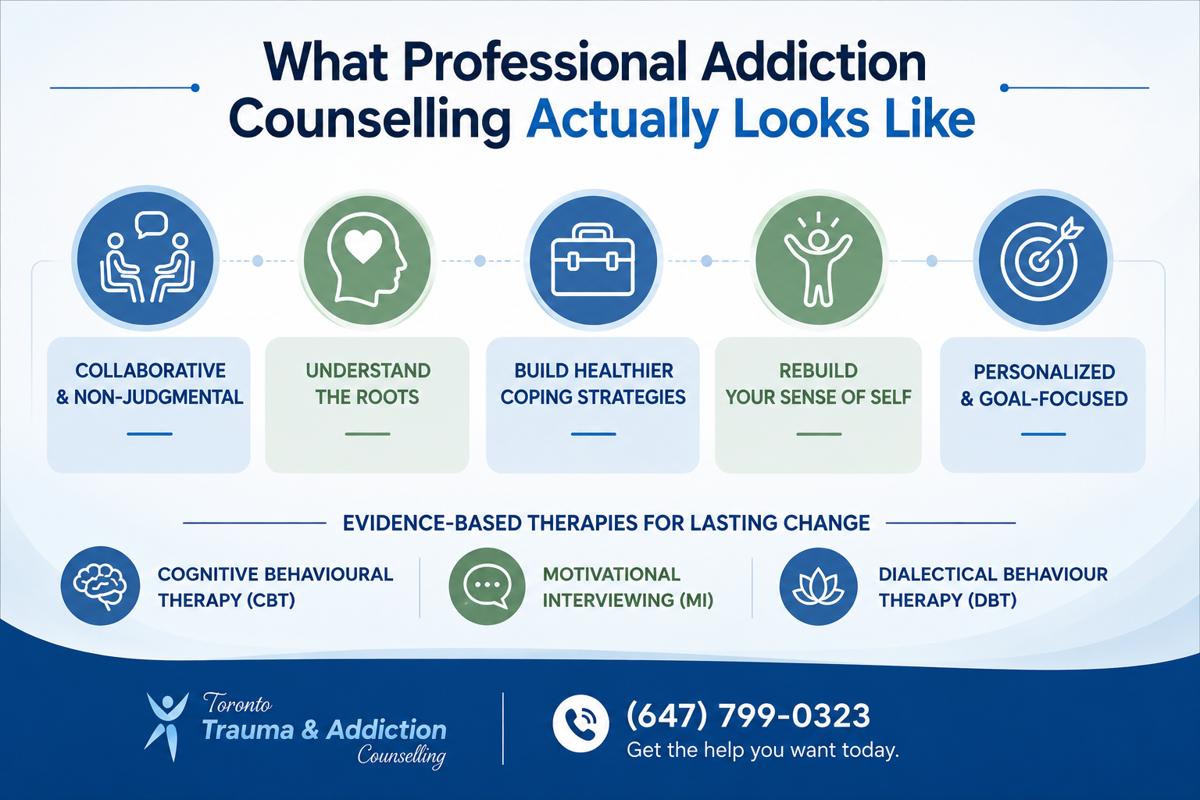
Professional addiction support is not a one-size-fits-all experience. Effective counselling is personalised, collaborative, and built around your specific history, circumstances, and goals.
At Toronto Trauma & Addiction Counselling, the approach is trauma-focused, which means therapists are trained to understand how past experiences shape present behaviour. Sessions are not about judgment. They are about uncovering the connection between emotional pain and substance use, developing healthier coping strategies, and rebuilding a sense of self that isn’t defined by addiction.
Evidence-based modalities are used both to help people make practical, lasting changes in their day-to-day lives and to explore the deeper underlying struggles that often sit beneath addictive behaviours. These are not abstract therapeutic exercises. They are concrete tools that clients carry with them into the real world, into the moments when cravings rise and old patterns knock at the door, while also helping people better understand and heal the emotional pain, trauma, or internal burdens that may have been present long before the addiction itself.
Dual Diagnosis: When Addiction and Mental Health Overlap
This is one of the most critical and often overlooked pieces of the addiction puzzle. A significant proportion of people struggling with drug addiction are also living with an underlying mental health condition, whether that’s depression, anxiety, PTSD, ADHD, or bipolar disorder. This is called a dual diagnosis, and it requires integrated treatment that addresses both conditions simultaneously.
When mental health struggles go unaddressed, they become a persistent trigger for relapse. A person may manage to stop using, but if their depression remains untreated, the emotional weight of it eventually becomes too heavy to carry without something to dull it. That’s when the cycle begins again.
Experienced addiction therapists understand this intersection deeply. They are trained to identify when mental health is contributing to substance use and to develop a treatment plan that attends to the full picture, not just the surface symptoms. Following drug addiction recovery steps that account for dual diagnosis is often what separates sustained recovery from repeated relapse.
For Families: You Are Not Alone in This Either
As mentioned earlier in this post, addiction doesn’t only affect the person using it. It radiates outward, touching partners, parents, children, and close friends in ways that are often profound and exhausting. Loved ones frequently find themselves cycling through patterns of enabling, withdrawing, anger, and grief, without any real guidance on how to help without losing themselves in the process.
Professional help is available not only for the individual but for the people who love them, including dedicated support for prescription drug addiction and other substance use issues. Family counselling and support for partners are an important part of the recovery ecosystem. Understanding addiction, setting healthy boundaries, and learning how to be supportive without becoming codependent are all skills that can be developed with the right professional guidance.
Therapy for family members is not only about learning how to respond to addiction more effectively. Many partners, spouses, children, and loved ones experience significant emotional pain, chronic instability, and at times deep trauma as a direct result of living with someone in active addiction. Part of the work is therefore also helping those individuals rebuild their own sense of safety, stability, identity, and emotional well-being, rather than remaining consumed solely by the addiction and its impact on the family system.
The Government of Canada’s substance use resource page offers helpful guidance on the range of treatment and support options available, including support specifically designed for families navigating this alongside a loved one.
If someone in your life is struggling and you’re not sure how to help, reaching out to a counsellor is a completely appropriate and courageous first step for you too.
What to Look for When Choosing the Right Support
Not all addiction support is created equal, and finding the right fit matters. When exploring your options, look for a provider who offers individualised treatment rather than a rigid program, therapists with specific training in addiction and co-occurring mental health conditions, a confidential environment where you feel genuinely safe to be honest, and an approach that treats you as a whole person rather than a diagnosis.
Toronto Trauma & Addiction Counselling offers one-on-one counselling in a private, judgment-free setting. Whether you are at the beginning of your journey or somewhere in the middle of one, support is available at a pace and in a format that works for you. Confidentiality is not just a promise. It is the foundation of the work. For a broader overview of what evidence-based treatment involves and what questions to ask when choosing care, Health Canada’s dedicated page on substance use treatment is a useful and trustworthy starting point.
Crisis and Immediate Support: When You Need Help Right Now
For some people reading this, the situation may feel urgent. If you or someone you know is in immediate distress due to substance use, crisis support is available. In Toronto, organisations such as the Gerstein Crisis Centre and the Drug and Alcohol Helpline offer around-the-clock support.
Reaching out in a crisis is never the wrong move. It is, in fact, one of the most courageous things a person can do. Professional addiction counselling can then be the structured, ongoing support that follows once the immediate moment has passed.
The First Step Is Simpler Than You Think
There is something that happens when a person finally decides to reach out for help. Something shifts. Not because the road ahead suddenly becomes easy, but because for the first time, they are no longer walking it alone.
Recovery is not a single event. It is a process, and it looks different for everyone. But what the research consistently shows, and what experienced therapists see again and again in their work, is that professional support dramatically improves the likelihood of sustained, long-term recovery. Not just stopping. Healing.
If you are ready to take that step, or even if you’re not entirely sure yet and simply want to explore what help might look like, you can reach out to speak with an addiction therapist today. Sometimes even an initial conversation can begin to make things feel a little clearer, a little more manageable, and a little less hopeless.
You’ve already done the hard part just by reading this far. The next step is simply reaching out.
Key Takeaways
- Drug addiction recovery is not just about stopping substance use. It is about understanding the emotional, psychological, and behavioural patterns behind it.
- Professional counselling provides structure, accountability, and evidence-based strategies that are difficult to create alone.
- Addiction often overlaps with trauma, anxiety, depression, or other mental health concerns, which makes integrated support especially important.
- Prescription drug addiction can be difficult to recognize, and specialized, confidential care can help.
- Toronto Trauma & Addiction Counselling offers private, trauma-focused support for individuals and families navigating addiction recovery.
Frequently Asked Questions
Why is professional help important for drug addiction recovery?
Professional help is important because drug addiction often involves brain changes, emotional triggers, trauma, mental health concerns, and behavioural patterns that are difficult to address alone. Addiction counselling provides structure, clinical insight, coping tools, and relapse prevention strategies that support more sustainable long-term recovery.
Can I recover from drug addiction without counselling?
Some people reduce or stop substance use without formal counselling, but many struggle with relapse when the underlying causes remain untreated. Professional support helps identify triggers, address emotional pain, and build practical recovery skills, which can make the process safer, more stable, and more effective.
What happens during drug addiction counselling?
Drug addiction counselling usually involves exploring your substance use patterns, identifying emotional triggers, addressing trauma or mental health concerns, and developing healthier coping strategies. Sessions are confidential and personalized, allowing you to work at a pace that reflects your goals, readiness, and lived experience.
How do I know if my drug use has become an addiction?
Drug use may have become an addiction if you feel unable to stop, use more than intended, experience cravings, withdraw from responsibilities, or continue using despite negative consequences. A professional assessment or self-assessment questionnaire can help clarify the severity of your substance use patterns.
Is counselling helpful for prescription drug addiction?
Yes. Prescription drug addiction can be complex because the medication may have started as legitimate treatment. Counselling can help you understand dependency patterns, manage shame or confusion, address underlying emotional triggers, and build a safer plan for recovery with professional support.