
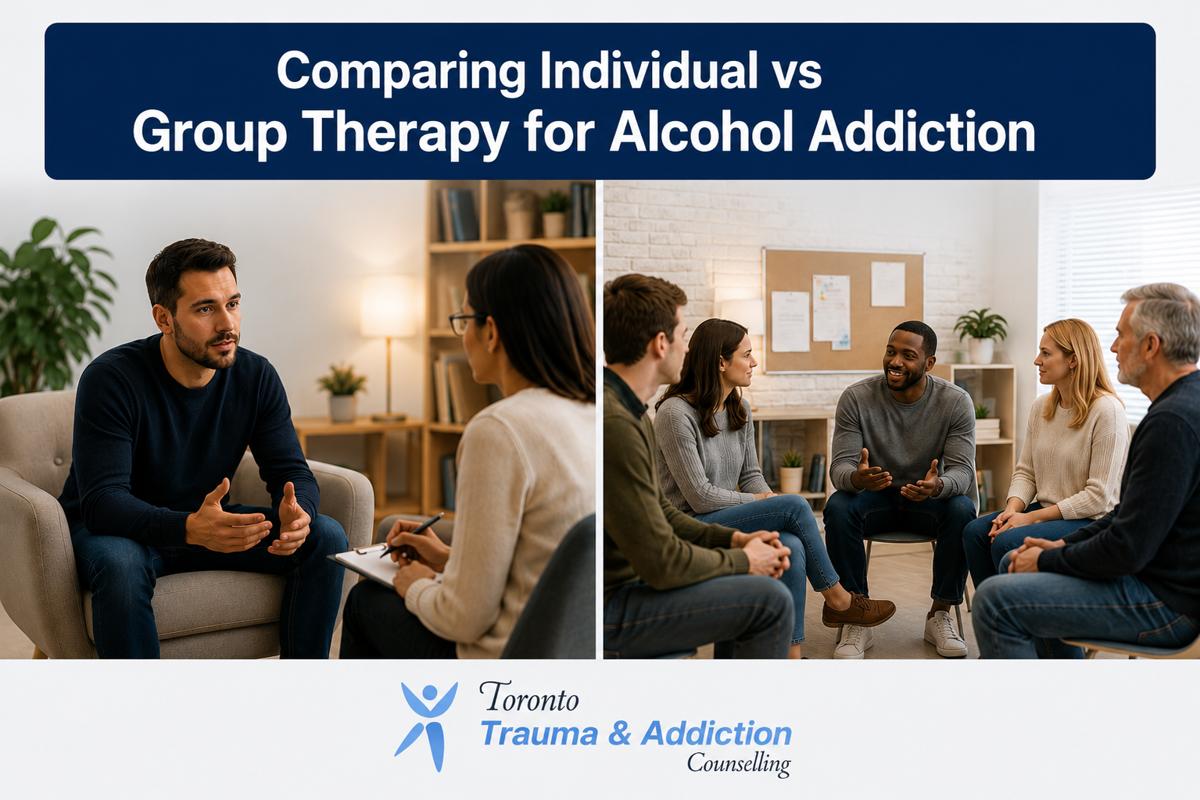
Alcohol addiction therapy is a structured, evidence-based treatment approach that helps individuals understand and overcome their dependence on alcohol by addressing both the behavioural patterns and the underlying emotional causes driving it.
What This Guide Covers
- Individual therapy offers private, highly personalized support focused on your history, emotional patterns, and recovery goals.
- Group therapy creates connection, accountability, and shared understanding through professionally guided peer support.
- Neither approach is universally “better.” The right choice depends on your comfort level, emotional needs, and stage of recovery.
- Many people benefit most from combining individual and group therapy as their recovery evolves over time.
- Effective alcohol addiction therapy should adapt to you, not force you into a rigid treatment model.
What Is Individual Therapy for Alcohol Addiction?
Individual therapy is a private, one-on-one relationship between you and a trained addiction therapist. Sessions are built around your specific history, your emotional patterns, your triggers, and your unique relationship with alcohol.
This is where trusted alcohol addiction counselling in Toronto often begins, particularly for people who are not yet ready to speak in front of others, or who have complex histories that require a confidential, focused space to work through.
There is no audience. No comparison to someone else’s progress. No timeline that belongs to anyone but you.
The Advantages of Individual Therapy
Individual therapy offers something that no group setting can fully replicate: undivided, personalized attention. Every session is built around your experience, meaning nothing gets glossed over and nothing is shaped to fit a collective pace.
This depth matters especially for people navigating co-occurring mental health conditions, trauma, or layered family histories. Understanding how trauma can influence alcohol use often requires room to speak slowly, revisit difficult territory, and receive care that is specifically calibrated to you.
Other clear advantages include:
- Flexible scheduling that works around your life, not a group calendar.
- A quieter entry point for those who are introverted or early in recovery.
- Strict confidentiality, which can feel essential when you are first ready to speak.
Where Individual Therapy Has Its Limits
Individual therapy, for all its strengths, can feel isolating. Addiction by nature breeds loneliness, and a weekly session, however meaningful, does not replace the steadying presence of a community that understands you from the inside.
There is also a particular kind of insight that only comes from hearing someone else’s story and recognizing yourself in it. That moment of recognition, the quiet shock of realizing you are not alone, is something individual therapy cannot fully replicate.
For people in longer-term recovery, the absence of peer connection can slow progress in ways that are easy to miss until they become significant.
What Group Therapy Actually Looks Like
Group therapy is a structured, therapeutically facilitated space where people at various stages of alcohol addiction recovery come together to share, listen, and learn. A trained therapist guides the sessions while participants contribute their own lived experiences.
It is not a room full of strangers competing in their vulnerability. It is a contained, professional environment where honesty is encouraged and progress is witnessed. The NIH’s clinical literature on group therapy for substance use notes that a skilled group leader can harness the group’s natural curative forces to foster healthy attachments, positive peer reinforcement, and new social skills, making it comparable in many cases to individual therapy.
For many people, exploring alcohol addiction treatment options beyond the one-on-one setting begins here.
The Advantages of Group Therapy
One of the most powerful elements of group therapy is normalization. When you hear someone else articulate something you have never been able to say out loud, the shame around it begins to soften. That softening is not a small thing. It is often where healing actually starts.
Group therapy also develops something that addiction frequently erodes: genuine intimacy, meaning the capacity to be truly known and to truly know another person. A well-run group becomes a live practice ground for exactly that kind of connection.
Additional advantages include:
- Shared coping strategies that expand your toolkit beyond what any single therapist can offer.
- Accountability that comes from showing up to the same faces, week after week.
- Motivation drawn from watching others make real progress, not just hearing that it is possible.
Where Group Therapy Has Its Challenges
Group settings require a degree of readiness. Walking into a room where others have been doing the work longer than you can feel discouraging rather than motivating, especially in early recovery.
For those who are introverted, socially anxious, or who have experienced harm in group-based settings before, fully accessing the space can take time and intentional support. If speaking in groups does not come naturally, that is worth discussing openly with a counsellor before committing to the format.
Group therapy also has natural depth limits. Personal, layered histories often require more focused attention than a shared session can provide on its own.
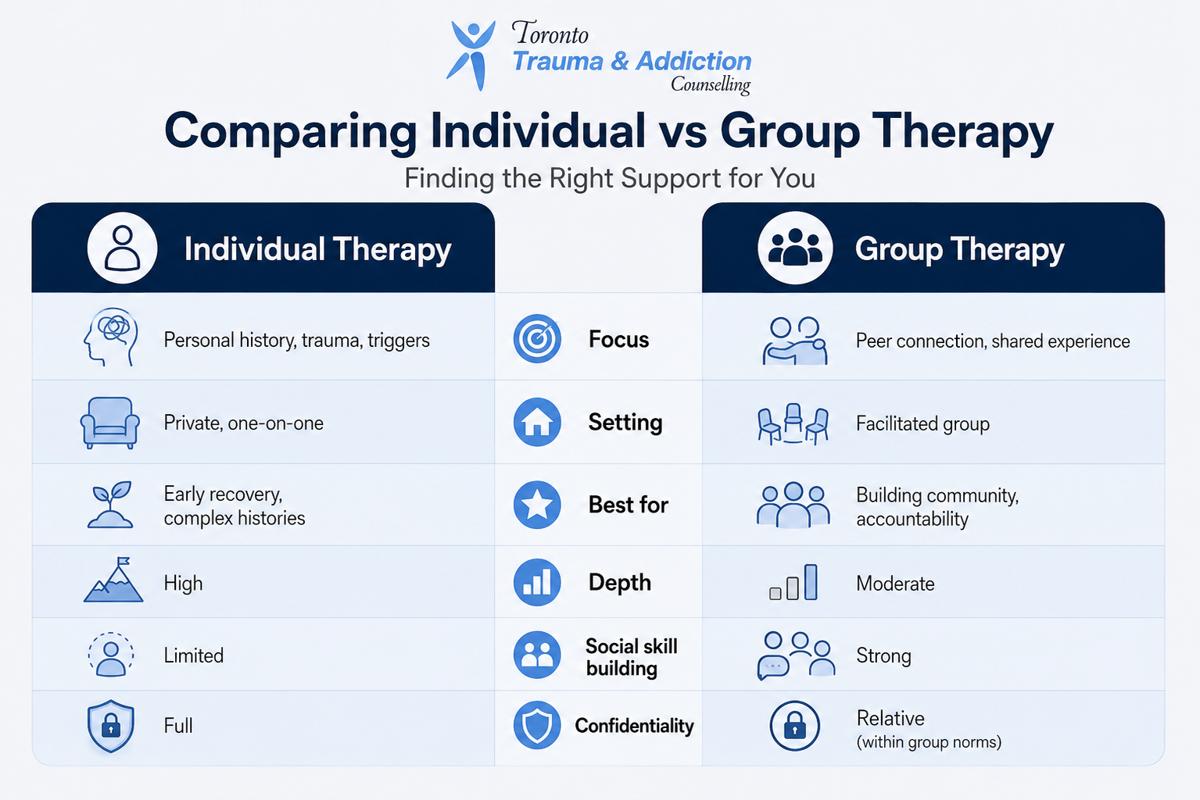
Individual vs. Group Therapy: A Direct Comparison
These two approaches are not in competition. They address different dimensions of recovery at different moments. As Health Canada notes, there is no single approach to substance use treatment, and the right choice depends on each person’s circumstances.
| Individual Therapy | Group Therapy | |
| Focus | Personal history, trauma, triggers | Peer connection, shared experience |
| Setting | Private, one-on-one | Facilitated group |
| Best for | Early recovery, complex histories | Building community, accountability |
| Depth | High | Moderate |
| Social skill building | Limited | Strong |
| Confidentiality | Full | Relative (within group norms) |
Research consistently supports the effectiveness of both approaches when properly matched to a person’s needs. The question is never which is better in the abstract. It is which is better for you, right now, in this chapter of your recovery.
Can You Do Both? Combining Individual and Group Therapy
Yes. And in many cases, a combined approach is the most effective strategy available.
Individual therapy creates the private foundation: the insight, the emotional safety, the space to process what is too raw or complex for a group setting. Group therapy then extends that work into the relational world, testing new skills, building community, and offering a broader sense of possibility.
Many people begin with individual therapy, especially if they are newly sober or working through significant trauma, and then transition into group work as they build confidence and stability. Others start in group settings and find that individual therapy deepens and sustains that progress. Both sequences are valid.
What matters is that the approach evolves as you do.
How to Evaluate What You Actually Need Right Now
This may be the most important section of this entire piece, because the most effective therapy is the therapy you can genuinely engage with.
Start by asking yourself honest questions:
- Are you comfortable speaking in front of others, or does that feel like a real barrier right now?
- Do you have unresolved trauma or mental health concerns that feel too private for a group space?
- Do you have an existing support network, or would the social element of group therapy fill a meaningful gap?
A useful starting point is to evaluate your alcohol use patterns and consider what has and has not worked in the past. If you have tried one approach and it did not hold, that is information, not failure.
It is also worth reviewing the signs of alcohol dependency honestly, because the severity and duration of your relationship with alcohol can shape which form of support will meet you most effectively at the start.
CAMH’s alcohol use treatment resources offer a helpful framework for understanding where someone sits on the spectrum and what level of care may be most appropriate, whether that is outpatient counselling, intensive support, or a structured program.
The Therapeutic Modalities Behind the Work
Whether you choose individual, group, or a combination, quality alcohol addiction therapy draws on established clinical frameworks. These are not just clinical labels. They are structured, evidence-based tools.
Cognitive Behavioural Therapy (CBT) helps identify and interrupt the thought patterns that drive drinking. Motivational Interviewing works with ambivalence rather than against it, meeting people where they are rather than where a therapist wants them to be. Internal Family Systems (IFS) helps people better understand the different “parts” of themselves that may be driving addictive behaviours, including the parts that seek relief, escape, numbness, or protection through alcohol, while also helping uncover and heal the deeper emotional wounds those parts may be carrying. EMDR is often used to help process unresolved trauma and distressing life experiences that may continue to fuel addiction long after the original events occurred. Trauma-focused care recognizes that for many people, alcohol has been a coping mechanism for pain that predates the addiction itself.
The NIAAA’s Alcohol Treatment Navigator provides a clear breakdown of how some of these therapy approaches work alongside other treatment options, and is a useful reference for anyone wanting to understand the clinical landscape before their first session.
Our experience in addiction counselling has shown, consistently, that the therapeutic relationship itself is one of the most powerful variables in lasting recovery. The right modality matters. The right therapist matters more.
You Do Not Have to Figure This Out Alone
Choosing the right form of therapy can feel like one more decision in an already exhausting time. You do not have to make it perfectly. You just have to make it.
At Toronto Trauma & Addiction Counselling, every approach is personalized. There is no single template, no one-size-fits-all prescription. Therapy is built around your history, your goals, and your readiness, with the flexibility to shift as your needs evolve. That is what genuinely effective care looks like.
If you are ready to take the next step, book a confidential counselling session and start with a conversation. That is all it takes to begin. One honest conversation, in a space where you are met without judgment, and where your recovery is treated with the seriousness and care it deserves.
The path is yours. The support is here.

Key Takeaways
- Individual therapy provides deep, personalized, confidential support ideal for early recovery and complex personal histories.
- Group therapy builds community, accountability, and the kind of relational healing that peer connection uniquely enables.
- Combining both is often the most effective long-term strategy, and many people move between formats as their needs evolve.
- The right fit depends on you, not on which format is theoretically superior.
- Toronto Trauma & Addiction Counselling offers flexible, confidential, personalized support across individual and group therapy for alcohol addiction.
Frequently Asked Questions
Is individual or group therapy more effective for alcohol addiction?
Neither is universally superior. Research supports both approaches when matched appropriately to a person’s needs, history, and stage of recovery. Many people benefit most from a combination of both.
How do I know if I am ready for group therapy?
A good indicator is whether you feel stable enough to be present for others while still doing your own work. If you are very early in recovery or navigating significant trauma, individual therapy is often the more appropriate starting point.
What types of therapy are used in alcohol addiction treatment?
Common modalities include Cognitive Behavioural Therapy (CBT), Motivational Interviewing, Internal Family Systems (IFS), EMDR, and trauma-focused approaches to care. The approach used depends on your individual history, goals, and presenting concerns.
Can I switch between individual and group therapy during recovery?
Yes, and many people do. Recovery is not linear, and the right format for you at one stage may not be the right format six months later. A good therapist will help you navigate those transitions.
How do I get started with alcohol addiction therapy in Toronto?
The first step is a confidential consultation. Toronto Trauma & Addiction Counselling offers personalized assessments to help you understand your options and find the approach that fits your recovery goals.